
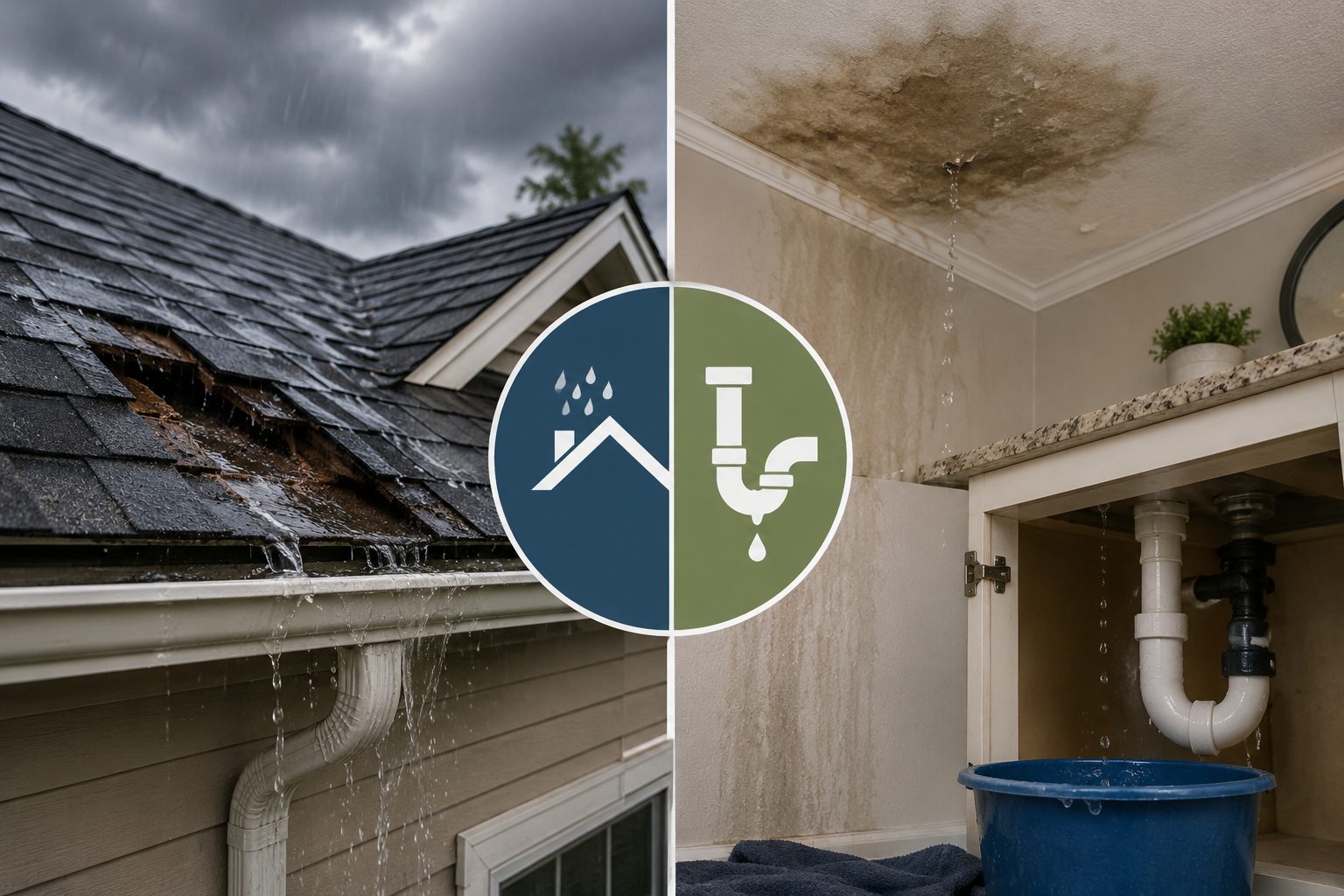
Water is coming in. You can see it. Maybe there’s a damp patch on the ceiling, a drip near the loft hatch, or a stain creeping across the bedroom wall. The panic sets in and then the question: who do you even call?
This is one of the most common and frustrating scenarios homeowners face. You’ve got water where it shouldn’t be, but you don’t know whether you need a roofer or a plumber. Get it wrong and you’ll pay twice, once for the wrong tradesperson to visit, and again when the right one finally sorts the actual problem.
So let’s work through it properly.
Why the Confusion Happens
Roofing and plumbing systems often run close together. Your loft space is busy, it’s where flat roof timbers sit, where tank cisterns live in older homes, where pipework crosses over joists, and where lead flashings around stacks and vents meet the roof covering itself.
When water appears inside, it’s almost never obvious which system has failed. Water travels. It runs along joists, drips off pipes, and pools in unexpected places before it finally shows itself on your ceiling. The leak could have started three feet away from where you’re seeing it.
Signs That Point Towards a Roof Problem
There are clues. Not certainties, but clues. These signs tend to suggest the roof is the culprit:
- Damp patches appear after heavy rain – and clear up in dry weather
- The stain is brown or yellow – a sign of rainwater carrying dirt and debris
- The damp is near the ridge, chimney, or roof edge – these are the most vulnerable points
- You’ve got missing, cracked, or slipped tiles – even one compromised tile can let water in during a driving storm
- The property is older – lead flashings and felt underlays degrade over time, sometimes quietly for years before showing inside
- You can see daylight in the loft – if you can, water can certainly find a way in
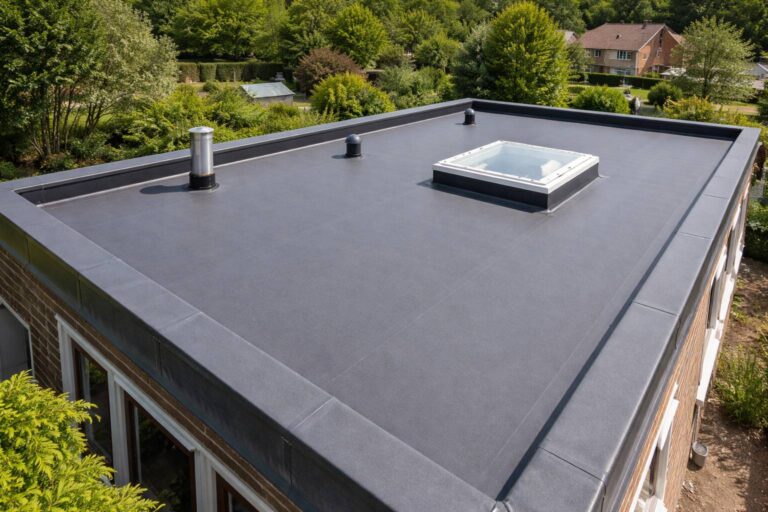
Flat roofs are particularly prone to pooling and membrane failure. If your extension or outbuilding has a flat roof and water is appearing on the ceiling below after rain, that’s almost certainly a roofing issue, the membrane has split, bubbled, or the edge trim has failed.
Signs That Point Towards a Plumbing Problem
Plumbing leaks behave differently. Here’s what to look for:
- Damp appears regardless of weather – if it’s wet on a dry day, it’s probably not the roof
- You can hear dripping or running water – behind walls or above ceilings
- Water stains appear near pipework routes – bathroom above the damp patch? Think plumbing first
- There’s a sudden increase in your water bill – this suggests a pressurised leak somewhere in the system
- The damp is warm – cold water pipes leak cold, but central heating pipes and hot water pipes carry warmth that can come through
- Mould develops quickly – plumbing leaks tend to be consistent, which creates ideal conditions for mould growth faster than intermittent rainwater ingress
If you’ve got a bathroom directly above a damp ceiling patch, don’t immediately assume it’s the roof. Shower trays crack. Silicone sealant fails around baths. Overflow pipes get blocked. A dripping joint behind a wall panel can cause significant damage over weeks or months without anyone realising. In this case it is best to contact a local plumber like Royal Flush Plumbing Norwich for inspection.
When It’s Actually Both
Here’s where things get complicated. There are scenarios where a roof failure and a plumbing problem exist simultaneously or where one causes the other.
Scenario one: The overflow pipe
Many homes still have cold water storage tanks in the loft. If the ballcock fails and the tank overflows, water runs across the loft floor and can exit through any weakness in the roof structure, usually around a soil stack or vent pipe. The homeowner sees water coming in near the roof and assumes it’s a roofing problem. In reality, the tank is overflowing. A roofer visits, finds no obvious roof fault, and leaves. The plumber is called second.
Scenario two: Condensation compounded by a roof defect
This one’s subtle. Poor roof ventilation causes condensation to build up in the loft. That moisture settles on timbers, pipework, and insulation. If there’s also a small roof defect, say, a cracked tile letting in occasional moisture, the two problems combine. The timbers never fully dry out. Wet rot sets in. You end up needing both a roofer and potentially a structural assessment.
Scenario three: The soil stack and flashing combination
Every roof has penetrations, pipes, vents, and soil stacks that come up through the roof covering. Each one is sealed with a flashing or a rubber collar. These degrade. When they fail, rainwater can track down the outside of the pipe and into the property. You’ll see damp near a soil pipe and immediately think blocked drain or leaking pipe. But the pipe itself is fine, it’s the roof seal around it that’s gone.
What to Do First
Before you call anyone, do your own investigation. It doesn’t need to be thorough, just enough to give a tradesperson useful information.
Step one: Check the weather correlation
Keep a simple note on your phone. Does the damp get worse after rain? Does it appear in dry spells too? A week of observation can save you money.
Step two: Go into the loft
If it’s safe to do so, get up there with a torch. Look for:
- Daylight coming through the roof covering
- Wet or stained timbers
- Condensation on cold surfaces (pipes, underside of roof deck)
- Any visible water pooling or dripping
Step three: Check the bathroom above
Push the silicone around your bath or shower tray. If it lifts away easily, it’s failed. Run the shower and watch for any water escaping at the base. Check the condition of grout in tiles. These are quick checks that can confirm or rule out a plumbing source.
Step four: Look at your water meter
Turn off every tap and appliance in the house. Check your meter. Wait 30 minutes without using any water. Check again. If the meter has moved, you have a live water leak and that’s a plumbing job.
Who to Call and When
Once you’ve gathered your information, it becomes easier to direct the call.
Call a roofer if:
- The damp is clearly linked to rainfall
- You’ve spotted missing, cracked, or slipped tiles
- The problem is near a chimney, ridge, parapet, or flat roof area
- Your loft shows signs of water entry from above
Call a plumber if:
- The damp appears in dry weather
- Your water meter shows usage when everything is off
- There’s a bathroom or wet room directly above the affected area
- You can hear running or dripping water
Call both if:
- You genuinely can’t establish a cause
- Your loft has both roof defects and pipework problems visible
- There’s an overflow tank involved
It’s worth being honest with tradespeople when you book. Tell them what you’ve observed, the weather correlation, the meter check, what you found in the loft. A good roofer or plumber will tell you quickly if it’s outside their scope, and most will do so without charging for a wasted visit if you’ve communicated clearly upfront.
The Cost of Getting It Wrong
Misdiagnosing a leak is expensive. Not catastrophically so but frustratingly so.
A roofing inspection call-out typically costs between £50 and £150 in most parts of the UK. If the roofer finds nothing wrong, that money is gone. A plumber’s callout is similar. If you’ve paid for two wrong diagnoses before the right tradesperson is called, you could be £300 down before any repair has been done.
More seriously, delay causes damage. Water in a ceiling causes plaster to fail. Sustained moisture causes timber to rot. Mould spreads. A small roof defect that would have cost £150 to fix with a couple of new tiles and fresh pointing can become a much larger job if water has been sitting in the loft for six months.
The Bottom Line
Don’t guess. Don’t assume. And don’t automatically book whoever is cheapest or available soonest without thinking it through.
Water in your home is stressful but a few minutes of careful observation will almost always give you enough information to point you in the right direction. Check the weather pattern. Check the loft. Check the bathroom. Check the meter.
And if the answer is still unclear? That’s fine too. Say so when you book. A competent tradesperson can often tell within minutes of arriving whether the problem is theirs to solve and they’ll point you straight to the right person if it isn’t.