

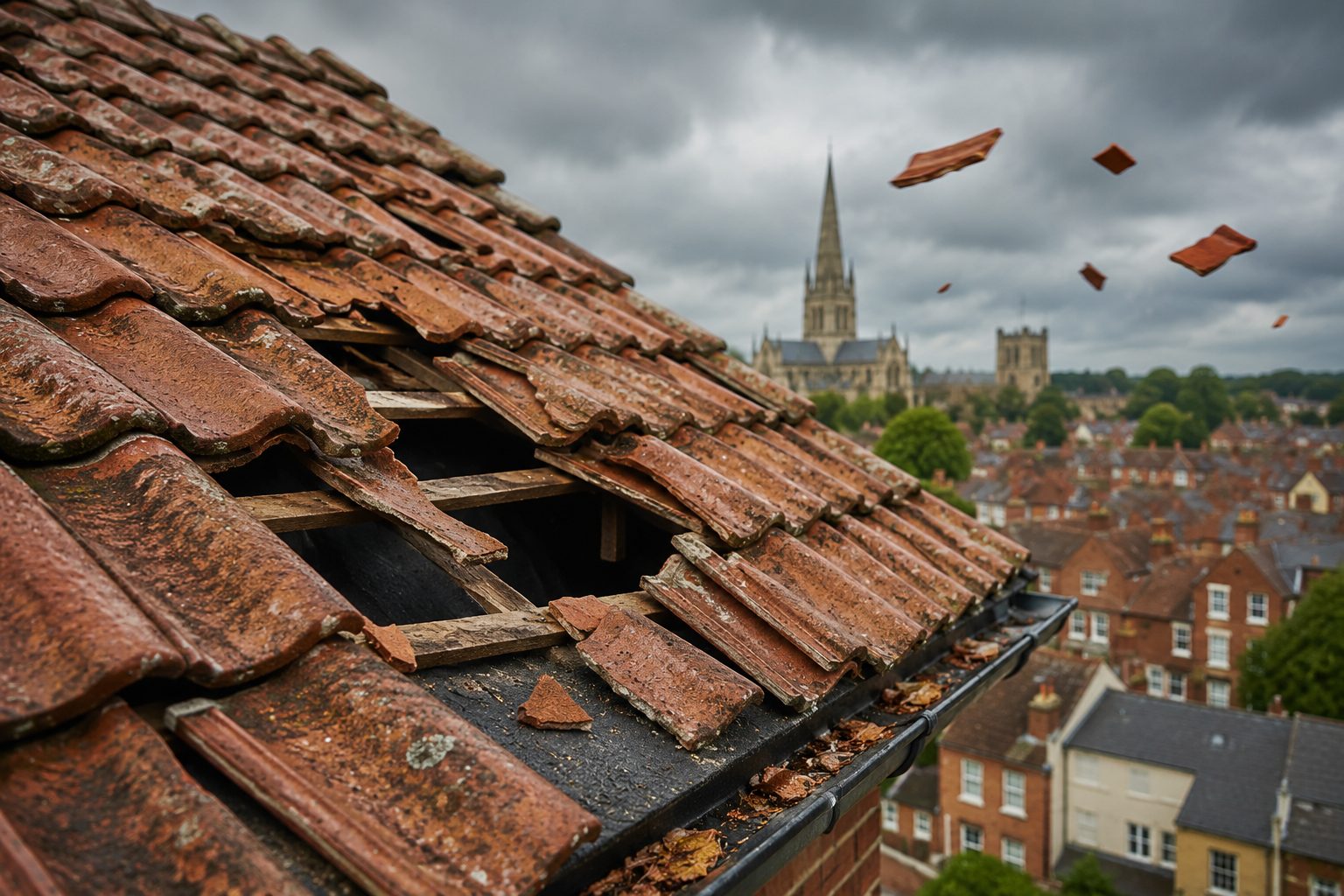
Your roof looks fine from the street. That’s what most people think, right up until water starts coming through the ceiling.
Tile loss is one of those problems that creeps up quietly. No dramatic warning signs. No obvious moment when things went wrong. Just a slow, invisible process that picks up pace every time the temperature drops or the wind rolls in off the Fens.
And in Norwich, it happens more often than people expect.
The Norwich Climate Is Harder on Roofs Than Most People Realise
We’re not the wettest part of the UK. Anyone who’s spent a summer here knows that. But annual rainfall figures don’t tell the whole story, it’s what the weather does to your tiles over time that matters.
Norwich gets cold, sharp winters. Easterly winds cut across from the North Sea with very little to slow them down. And the freeze-thaw cycle, where temperatures dip below zero overnight then climb again by morning, hammers away at mortar and tile surfaces throughout November, December, and January.
Here’s what that actually does to your roof:
- Freeze-thaw damage – Water seeps into hairline cracks in the mortar or tile surface. It freezes overnight. It expands. It thaws. Then it does the same thing again, three nights later. Do that forty or fifty times across a single winter and those hairline cracks become real ones.
- Wind exposure – Norwich is flat. Areas like Sprowston, Hellesdon, and Thorpe St Andrew sit on slightly raised ground with very little natural windbreak. Roofs there take a real battering between October and March.
- Thermal stress – Hot summers, cold winters. Roof materials expand and contract with the seasons. Over years, that movement weakens fixings and loosens tiles that once sat perfectly firm.
None of this is dramatic. It’s just relentless. And that’s exactly what makes it easy to miss.
Older Homes Carry More Risk Than Their Owners Often Realise
Norwich is a beautiful city, partly because so much of the old architecture is still standing. Victorian terraces in the Golden Triangle. Edwardian semis in Eaton. Post-war housing spreading out through Lakenham, Bowthorpe, and Mile Cross.
But older housing stock means older roofs. And older roofs come with their own particular vulnerabilities:
- Ageing clay or concrete tiles that have been through decades of freeze-thaw cycles
- Crumbling lime mortar that was never designed to last a century
- Roof timbers that have shifted slightly over the years, changing the way tiles sit and drain
In areas like Mousehold Heath and Thorpe Hamlet, you’ll often find roofs where some tiles have been replaced at various points over the decades but not all of them. The result is a patchwork of old and new that doesn’t always sit flush. Gaps appear between tiles. Wind finds those gaps. Tiles lift.
It’s not that these homes were built badly. It’s that roofs have a lifespan, and a lot of Norwich roofs are well into their second half of it.
How Much Tile Loss Are We Actually Talking About?
More than most people would guess.
A typical semi-detached house in Norwich has somewhere between 800 and 1,200 tiles, depending on pitch and roof design. During a moderate storm, not even a severe one, it’s entirely possible to lose ten to fifteen tiles in a single night. The problem is, you often don’t see them go. They end up in the gutters, behind the wheelie bins, or flat in the back garden where they’re easy to overlook.
After Storm Babet tore through Norfolk in October 2023, roofers across the city were inundated with call-outs. But here’s the thing, the storm didn’t cause most of those problems. It just exposed them. The mortar had already been failing. The tiles had already been loose. The storm just finished the job.
That pattern repeats itself every winter in Costessey, Bowthorpe, and across the south side of the city. By the time homeowners pick up the phone, the damage has usually been building for a long time.
It’s Rarely Just the Wind
When a tile comes off, the wind tends to get the blame. And yes, wind plays a role. But in most cases, there’s an underlying reason the tile was vulnerable in the first place.
- Nail fatigue – Tiles are fixed with nails or clips that corrode over time. Once a nail goes, the tile above it is basically sitting there under its own weight, waiting for a strong enough gust.
- Failed mortar – Ridge tiles and hip tiles depend almost entirely on mortar to stay in place. When that mortar cracks or washes out, there’s nothing holding them firm.
- Moss and lichen – Properties near the River Yare, Trowse, Whitlingham, parts of Thorpe St Andrew, tend to see heavier moss growth. Moss holds moisture against the tile, speeds up deterioration, and works its way into gaps that wouldn’t otherwise exist.
- Bad previous repairs – A mismatched tile, a poorly bedded repair, or the wrong type of mortar can create weak spots that affect the tiles around them for years.
- Falling debris – Overhanging trees are everywhere in areas like Eaton, Cringleford, and along Unthank Road. Branches, conkers, and seed pods hit tiles harder than you’d think, especially in autumn gales.
One loose tile creates an entry point. Water gets in. Timbers get damp. Adjacent tiles start to shift. What starts as a £150 fix can quietly snowball into something that costs twenty times that.
Warning Signs You Can Spot Without Getting on the Roof
You don’t need to climb a ladder to get a sense of whether something’s wrong. A few minutes with your eyes open can tell you a lot.
From outside:
- Tiles that look raised, offset, or slightly out of line with the rest
- Fragments or granules collecting in the gutters or on the patio
- Visible moss patches, especially ones that keep coming back after cleaning
From inside:
- Dark patches on ceilings, particularly after heavy rain
- Damp or musty smell in the loft
- Actual daylight visible through the roof when you’re up there in the dark
That last one is more common than you’d think. If you can see sky from inside your loft, you’ve already got a problem.
What to Actually Do About It
The good news is that most tile loss is preventable or at least manageable, if you stay ahead of it.
Get the roof checked regularly
Most Norwich roofers will do a visual inspection for free or a small call-out fee. For any property over 25 years old and that’s a lot of homes in Lakenham, Hellesdon, Mile Cross, and the city centre, a check every couple of years is worth doing. A good roofer with a drone can spot issues that are completely invisible from the street.
Don’t leave the ridge until last
The ridge is the most exposed part of your roof and the most likely to fail first. Repointing a full ridge on a typical Norwich semi costs somewhere between £400 and £900. That feels like a lot until you compare it to repairing water-damaged ceilings and rotting timbers.
Sort the gutters before winter
Blocked gutters push water back up against the roof edge. Over time, that causes the felt and tiles along the eaves to deteriorate faster. Properties with overhanging trees in Eaton, Cringleford, and Thorpe St Andrew need gutters clearing in late autumn without fail.
Deal with moss before it gets established
A biocide treatment roof clean followed by careful removal is the right approach. Don’t heavy duty pressure wash, it strips the surface coating from tiles and forces water into places it shouldn’t go.
Match your tiles properly
If you’re replacing a handful of tiles, use the same type and as close to the same age as you can find. Mixing old clay tiles with newer concrete ones changes the weight balance and can create problems that show up a few years down the line.
Repair or Full Re-Tile?
It’s the question every Norwich homeowner eventually faces.
If your roof is under 25 years old and the damage is contained, a few loose tiles, a small section of failed mortar, targeted roof repairs make sense. But if your roof is pushing 40 or 50 years old and a roofer is finding widespread nail fatigue, large areas of crumbling mortar, and multiple problem spots, the maths often start to favour a full re-tile.
A complete roof re-tile on a three-bedroom Norwich home typically runs between £5,000 and £12,000 depending on the pitch, access, and tile type. That’s not a small number. But measured against years of repeated emergency call-outs, interior water damage, and the risk of structural problems developing quietly in the timbers, it often works out cheaper in the long run.
The Thing Most Norwich Homeowners Get Wrong
They wait for an obvious sign.
A dripping ceiling. A tile on the lawn. A visible hole. By then, the problem has usually been developing for a year or more.
The homes that hold up best, whether that’s in Sprowston, Eaton, Hellesdon, or right in the heart of the city, aren’t always the newest. They’re the ones where the owners stayed curious. Where someone took ten minutes to look up at the roofline after a storm. Where a roofer got called before things got serious.
Your roof isn’t going to ask for help. But if you know what to look for, it’ll give you plenty of warning. Contact the Point Roofing team if you would like to discuss roofing works for your home.